

There was a time when a video game character could only move left, right, up, or down — never forward. Everything existed on one flat surface, the way a photograph has height and width but no actual depth to step into. Then, slowly, that flatness gave way. Players stopped looking at a world and started looking into one.
This is the story of how that happened — and why, decades later, it still hasn’t stopped happening.
The Flat World That Started It All
Early video games were built entirely in two dimensions. Think of titles like Pong or Space Invaders — paddles, blocks, and ships sliding across a flat plane with no real sense of depth. This wasn’t a creative choice; it was a hardware limitation. The computers and arcade boards of the era simply didn’t have the processing muscle to calculate depth, perspective, or volume in real time. Designers worked within that boundary and still managed to create games that hooked millions of players, proving that great design doesn’t always need extra dimensions to be addictive.
But ambition is a restless thing. Even in the 1970s, some developers were already dreaming bigger.
The First Cracks in the Flat Screen
The earliest experiments with three-dimensional space weren’t flashy. In 1973, a small team working at a NASA research facility built a maze-based shooting game that let players navigate corridors from a first-person viewpoint — arguably the first real attempt at putting a player inside a game world rather than looking down at it. It was rough, wireframe-simple, and far from anything resembling a modern 3D world, but the seed had been planted: what if the player could move through space instead of just across it?
Through the late 1970s and into the 1980s, this idea kept resurfacing. A tank combat game released in 1980 used vector graphics to let players roam an open battlefield, look around, hide, and strike from any angle — a level of freedom that felt almost magical for its time. A few years later, home computers got their own taste of 3D with a maze-survival title that put players face-to-face with a lumbering on-screen predator, using simple wireframe visuals to suggest depth where none technically existed.
None of these were “true” 3D by today’s standards. Most relied on clever illusions — vector lines, forced perspective, and pseudo-3D tricks — rather than fully rendered three-dimensional objects. But they proved something important: players wanted to step inside the game, not just watch it from the outside.

The Decade Everything Changed
If the 1970s and early 80s planted the seed, the early-to-mid 1990s is when it exploded into full bloom.
A small, scrappy studio of programmers obsessed with pushing PC hardware to its absolute limit released a first-person shooter that used a rendering trick called ray casting — firing virtual rays from the player’s viewpoint to calculate what walls and objects should look like. The result wasn’t technically full 3D either; it was a clever illusion layered on top of a 2D map. But it didn’t matter. Players felt like they were inside a building, turning corners, dodging enemies in real space. It was a sensation.
The same studio followed it up with an even more advanced version of that illusion, complete with texture-mapped surfaces and a darker, more atmospheric tone. It became one of the most influential releases in gaming history, inspiring an entire genre of first-person shooters and proving that “fake” 3D could still feel utterly real to the person holding the controller.
Then came the real breakthrough.
In the summer of 1996, that same group of developers shipped a game built on something genuinely new: a fully three-dimensional engine where every wall, enemy, and object existed as an actual polygon in three-axis space. Players could look up, look down, jump, and move along a true vertical axis for the first time. The lead programmer behind it had spent years obsessively optimizing code at the hardware level, and the result ran smoothly even on modest home PCs — a technical achievement that, in hindsight, changed the trajectory of the entire industry.
Around the same period, a Japanese console manufacturer released a now-legendary platforming game that took a beloved 2D mascot and rebuilt his entire universe in three dimensions — open courtyards, rotating cameras, and physics-based jumping that 2D sprites could never have allowed. It became the gold standard for how 3D movement and camera design should feel, influencing console game design for years afterward.
By the end of the decade, dedicated 3D graphics accelerator cards had become must-have hardware, fighting games were rendering fully modeled polygonal characters instead of flat sprites, and the industry had unofficially declared its direction: forward, into the third dimension, and there was no going back.

Why It Took So Long
It’s worth pausing on why this revolution unfolded over two full decades instead of happening overnight. Three-dimensional rendering isn’t just an art style — it’s a math problem. Every polygon, every light source, every camera angle requires real-time calculation, and the consumer hardware of the 1970s and 80s simply couldn’t keep up with the demand. It took a perfect convergence of faster processors, smarter rendering techniques, and increasingly affordable graphics hardware before 3D worlds could run at a playable speed in someone’s living room.
In other words, the vision of 3D gaming existed long before the technology could deliver it convincingly. The developers who finally cracked it weren’t just artists — they were engineers solving a hardware puzzle that the rest of the world hadn’t caught up to yet.
Today’s Craze: 3D Gaming Has Become the Default
Fast forward to now, and the question has flipped entirely. Where developers once had to justify why a game needed 3D, today the bigger surprise is when a major release doesn’t use it.
A few things define this current wave:
- Photorealism is no longer reserved for blockbuster budgets. Modern game engines now handle lighting, shadows, and ultra-detailed environments with a level of automation that was unthinkable a decade ago, letting even small studios produce visuals that rival big-budget productions.
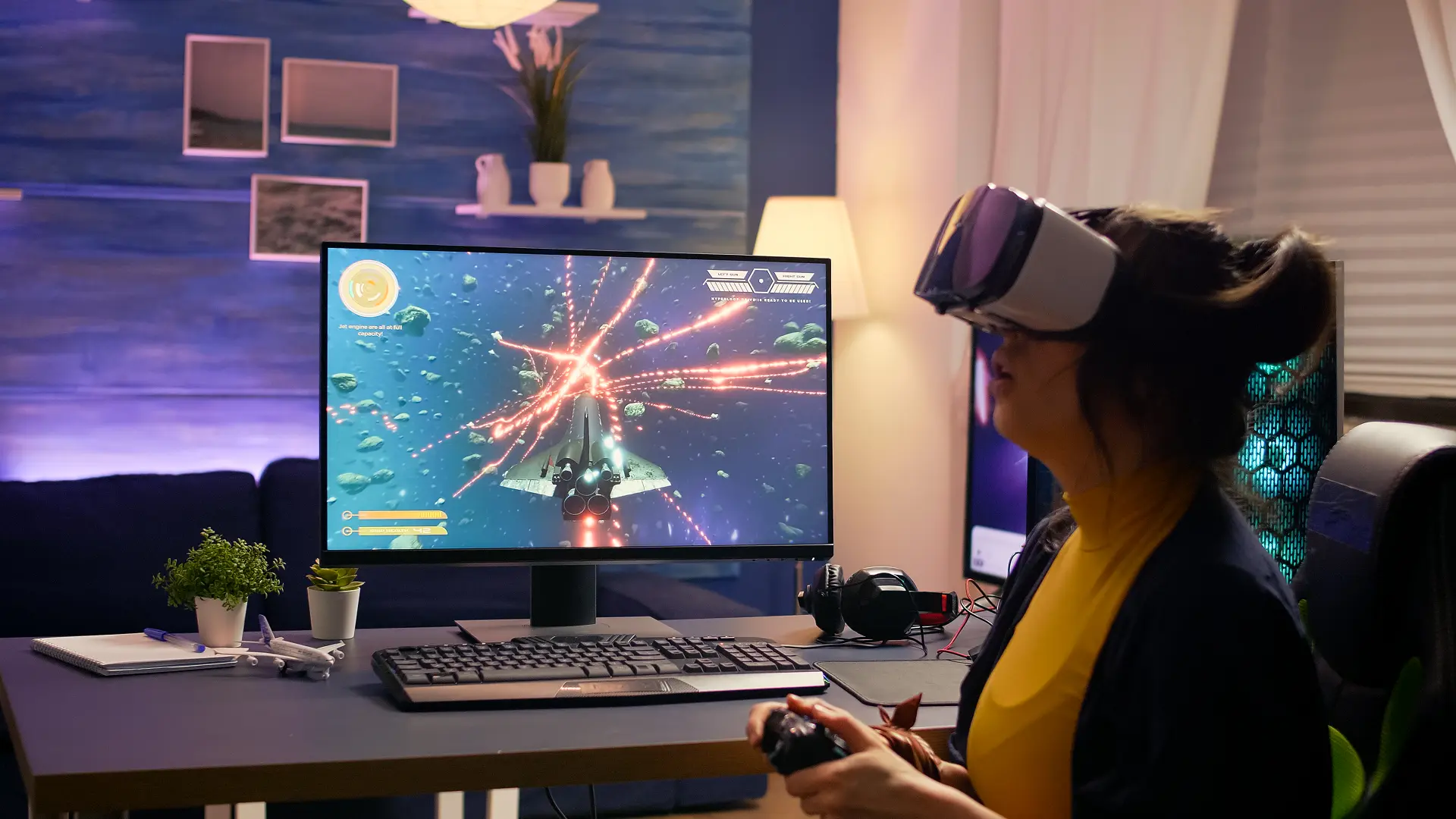
- Virtual and mixed reality have pulled 3D off the screen entirely. Headsets are putting players physically inside three-dimensional spaces, turning “looking at a 3D world” into “standing inside one.”
- AI-assisted tools are speeding up world-building. Where building a single detailed 3D environment once took entire teams months of work, newer pipelines are compressing that timeline dramatically, opening the door for solo developers and small studios to compete visually with giants.
- Stylized 3D is thriving alongside photorealism. Not every popular title is chasing real-world realism — plenty of today’s most talked-about games use deliberately artistic, low-poly, or hand-crafted 3D looks, proving that the craze isn’t about realism alone, but about depth, immersion, and spatial storytelling in general.
What started as a hardware limitation that forced developers to draw flat sprites has become an entire creative universe — one where game worlds aren’t just backgrounds anymore, but places players genuinely feel they can walk into, look around, and get lost in.
The Takeaway
The leap from 2D to 3D wasn’t a single moment — it was a slow, stubborn climb made by engineers and designers who refused to accept the limitations of their own era. From a wireframe maze built inside a research lab to gothic polygon corridors rendered in real time, every step came from someone asking the same question: what if the player could go further in?
Decades later, the answer is everywhere — in headsets, in cinematic AAA worlds, in indie passion projects built by a handful of people. The screen stopped being a window a long time ago. Now, it’s a door.